
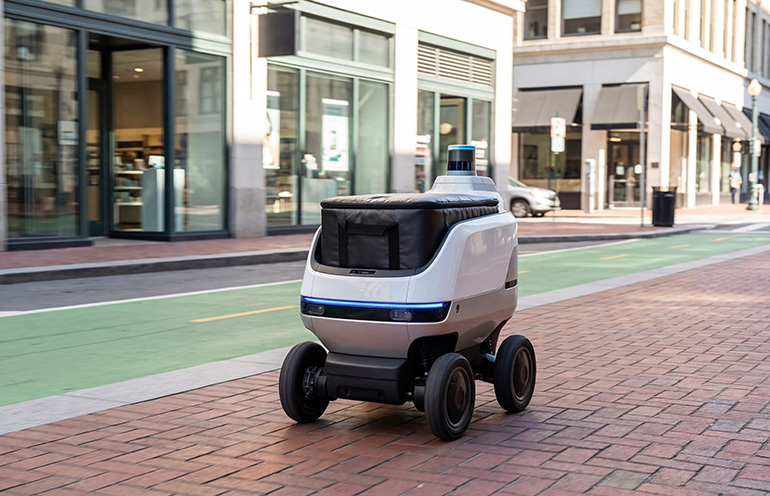
Agentic AI can combine perception, SLAM, reasoning, and planning in dynamic environments. Source: Nazlykhan AI, via Adobe Stock
Robots have achieved impressive levels of reliability in structured environments such as factories and warehouses, where layouts are predictable and tasks follow predefined workflows. The real world, however, rarely offers that level of stability. Environments like homes, disaster zones, construction sites, and outdoor logistics operations are unstructured, dynamic, and constantly changing, posing a challenge for navigation.
Traditional robotic navigation stacks rely heavily on pre-mapped environments, deterministic control pipelines, and rule-based decision logic. Techniques such as simultaneous localization and mapping (SLAM) allow robots to build maps and estimate position, but most systems still assume relatively stable surroundings.
These assumptions often fail when robots encounter moving obstacles, incomplete maps, or unfamiliar terrain, which limits many deployments to tightly controlled settings.
Agentic AI introduces a new approach. By enabling robots to perceive context, reason about goals, and choose actions dynamically, agentic frameworks enable more adaptive navigation. Let’s examine how these architectures enable general-purpose robotic navigation and integrate with existing robotics tech stacks.

From reactive robots to agentic navigation
Robotic navigation has evolved significantly over the past few decades. Early systems relied on reactive control architectures designed to respond to sensor inputs in real time. While effective for specific tasks, these approaches often lacked the ability to reason about goals or adapt to unfamiliar situations.
As robotics deployments expand beyond controlled environments, more flexible decision-making capabilities have become necessary.
Traditional robotics architecture
Most modern robots still follow a structured navigation pipeline:
Perception → Localization → Mapping → Planning → Control
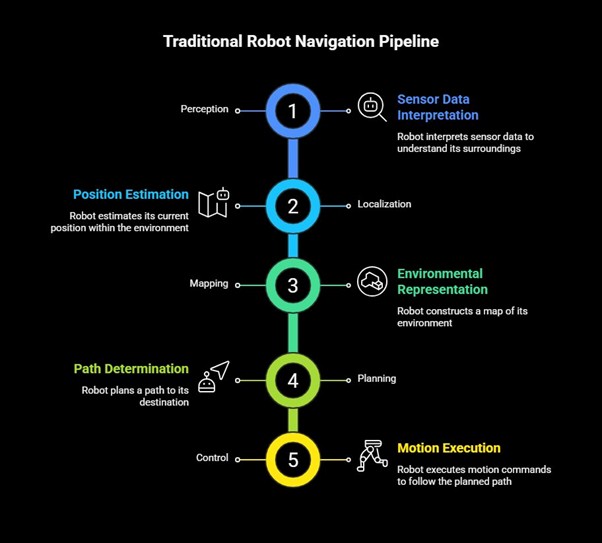
The traditional robot navigation pipeline. Source: Pratik Shinde
In this architecture, perception systems interpret sensor data, localization estimates the robot’s position, mapping constructs an environmental representation, planning determines a path, and control executes motion commands. The system is modular and reliable, but also rigid.
Earlier approaches, such as subsumption architectures, emphasized reactive behaviors, prioritizing sensor-driven responses rather than higher-level reasoning.
Limitations of traditional navigation stacks
Although effective in stable environments, traditional pipelines struggle with unfamiliar or rapidly changing conditions. These systems often assume prior knowledge of the environment and limited variability in obstacles or tasks. As a result, robots may behave unpredictably when encountering incomplete maps, new objects, or unexpected changes.
What agentic AI changes
Agentic AI introduces goal-driven planning, iterative reasoning loops, contextual memory, and dynamic tool use across the robotics stack. Rather than executing a fixed sequence of modules, agentic systems can orchestrate perception, planning, and control components based on the current objective.
Instead of relying on static navigation pipelines, robots begin to treat their capabilities as tools that can be invoked dynamically. Understanding how these capabilities work together requires examining the core components that power agentic robotic navigation.
Core components of agentic robotic navigation
Agentic robotic navigation builds on the traditional robotics stack but adds an orchestration layer that allows robots to reason about goals and dynamically coordinate different subsystems. In practice, these systems operate across four key technical layers.
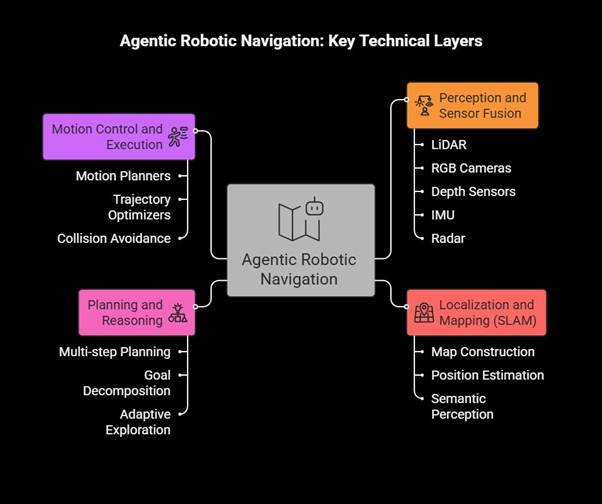
Agentic robotic navigation. Source: Pratik Shinde
1. Perception and sensor fusion
Robots first need a reliable understanding of their surroundings. Modern platforms combine multiple sensing modalities, including:
- Lidar for precise distance measurement
- RGB cameras for visual perception
- Depth sensors for spatial awareness
- Inertial measurement units (IMU) for motion tracking
- Radar for robust sensing in low-visibility conditions
Sensor fusion algorithms combine these signals to produce a consistent representation of the environment. Agentic frameworks extend this capability by allowing perception modules to be invoked dynamically depending on the task context, which helps robots interpret complex or rapidly changing environments.
2. Simultaneous localization and mapping
SLAM remains a foundational capability for autonomous mobile robots (AMRs). It allows them to construct maps of previously unknown environments and estimate their position within those maps.
Recent research combines SLAM with machine learning and semantic perception so robots can recognize objects and environmental features while mapping. Agentic systems enhance this process by selecting mapping strategies dynamically and updating maps continuously during exploration.
3. Planning and reasoning
Traditional navigation systems rely on algorithms such as A* or Dijkstra for path planning. Agentic architectures introduce higher-level reasoning capabilities such as multi-step planning, goal decomposition, and adaptive exploration strategies.
Some emerging frameworks integrate vision-language models (VLMs) with planning agents to reason about navigation tasks using semantic information from the environment.
4. Motion control and execution
Once a route is determined, robots execute movement using motion planners, trajectory optimizers, and collision-avoidance algorithms. These systems process real-time sensor feedback to adjust movement and prevent collisions.
Together, these components form the operational backbone of autonomous navigation. The key difference in agentic systems lies in how these capabilities are coordinated. Understanding that orchestration requires examining how agentic AI integrates with existing robotics software stacks.
How agentic AI can integrates with existing robotics stacks
Agentic AI does not replace traditional robotics infrastructure. Instead, it acts as an orchestration layer that coordinates existing modules within a robotics system. This approach allows developers to enhance autonomy without redesigning the entire software stack.
Integration with ROS and robotics middleware
Most modern robots rely on middleware frameworks such as the Robot Operating System or ROS2 to manage communication between perception, planning, and control modules. Agentic frameworks typically operate above these systems as cognitive control layers or task planners.
These agent layers interact with existing robotics infrastructure through standard interfaces and APIs used in platforms such as ROS and ROS2, NVIDIA Isaac, and simulation environments such as Gazebo or Isaac Sim.
In this setup, the agent monitors system state, evaluates goals, and decides which subsystem should execute the next action.
Tool-based navigation architecture
Agentic systems treat each robotics capability as a tool that can be invoked when needed. Common tools in a navigation stack include:
- SLAM and mapping modules
- Object detection and perception systems
- Path-planning algorithms
- Motion controllers
- Map query services
Instead of running these modules in a fixed sequence, the agent selects them dynamically based on environmental conditions and task objectives.
Dynamic workflow creation
Traditional navigation pipelines follow a fixed flow: perception, mapping, planning, and motion execution. Agentic architectures allow robots to construct workflows dynamically.
A robot may observe its surroundings, evaluate its goal, query the map, generate candidate paths, and choose the safest route before executing movement. This dynamic coordination improves robustness and adaptability when robots encounter unfamiliar or changing environments.
These capabilities become especially important when robots operate in environments that lack reliable maps or contain unpredictable obstacles.
Enabling navigation in unmapped and dynamic environments
Autonomous navigation becomes significantly more challenging when robots operate in environments that contain moving obstacles, unknown layouts, or incomplete maps.
Traditional navigation systems typically assume stable surroundings and reliable map data, which limits their effectiveness in real-world settings. Agentic AI helps address these limitations by enabling robots to reason about their environment and adapt their behavior as conditions change.
Context-aware decision making
Agentic systems interpret sensor data and environmental signals to make navigation decisions in real time. Instead of following a predefined route, an agent evaluates context through context engineering to determine where exploration should occur, when obstacles require avoidance or rerouting, and how navigation strategies should adapt to new information.
This reasoning layer helps robots respond more intelligently to unexpected situations.
Exploration strategies
In previously unmapped environments, robots must explore while simultaneously building an understanding of the space. Agentic frameworks can support incremental map creation, goal-driven exploration, and route planning during exploration.
Recent research also combines semantic perception with mapping so robots can recognize objects and structural features while navigating.
Adaptation to dynamic environments
Machine-learning-based navigation systems increasingly use predictive models to anticipate moving obstacles and adjust trajectories accordingly. This capability enables robots to operate safely around people in environments such as warehouses, hospitals, urban delivery routes, and disaster response sites.
As these capabilities mature, agentic navigation is beginning to unlock new categories of real-world robotic applications.
Emerging applications of agentic navigation
As agentic AI improves robotic decision-making and environmental awareness, it begins to unlock new applications across industries. Robots that once required tightly controlled environments can now operate in more complex and unpredictable settings.
1. Autonomous mobile robots
Autonomous mobile robots already play an important role in warehouses, manufacturing facilities, and fulfillment centers. Agentic navigation improves their ability to operate in dynamic spaces where layouts change frequently or humans share the same workspace.
By reasoning about obstacles and adapting routes in real time, these robots can maintain efficiency while improving safety during human-robot interaction.
2. Service and domestic robots
Robots designed for homes or service environments face highly unpredictable conditions. Furniture layouts, household objects, and human behavior can change constantly.
Agent-based navigation systems combine perception, reasoning, and contextual understanding so robots can navigate cluttered spaces and respond appropriately to human activity.
3. Inspection and industrial robots
Inspection robots are increasingly used to monitor infrastructure such as factories, pipelines, and power plants. These environments often include narrow passages, irregular structures, and changing conditions. AI-enhanced SLAM systems help these robots navigate complex industrial spaces while adapting to environmental changes.
4. Exploratory systems
Agentic navigation also supports robots operating in remote or hazardous environments. Examples include underwater vehicles, aerial drones, and planetary exploration robots. In these scenarios, multi-agent architectures help coordinate perception, planning, and mission objectives with minimal human intervention.
Despite these advances, several technical and operational challenges still limit the widespread deployment of agentic robotic navigation systems.
Key challenges and limitations
Despite rapid progress, agentic robotic navigation remains an emerging field with several technical and operational challenges that researchers and engineers continue to address. Current systems must balance autonomy, safety, and real-time performance before large-scale deployment becomes feasible.
- Computational demands: Agentic reasoning often relies on large models, reinforcement learning policies, and complex inference pipelines. These systems require significant computing resources to process sensor data and make decisions in real time, which can strain onboard hardware in mobile robots.
- Safety and reliability: Robots operating autonomously must maintain predictable behavior, robust obstacle avoidance, and compliance with safety standards. Ensuring safe decision-making becomes especially challenging when AI systems interact with dynamic environments and humans.
- Real-world deployment constraints: Autonomous systems must operate under hardware limitations, energy constraints, and strict latency requirements while still performing complex reasoning tasks.
- Explainability and debugging: Engineers must understand why an agent selects a specific action or navigation strategy, yet interpreting AI-driven decisions remains difficult in many systems.
Addressing these challenges will shape the next stage of innovation in autonomous robotics and agentic navigation systems.
Agentic AI promises to make robots more agile
Agentic AI has the potential to shift robotics from narrowly programmed machines to more general purpose autonomous systems capable of adapting to diverse environments. Instead of performing a single predefined task, future robots may combine perception, reasoning, and planning to operate across a wide range of scenarios.
Several technological trends are shaping this shift:
- Multi-agent coordination: Teams of robots collaborating to explore environments, share maps, and coordinate navigation tasks.
- Integration with world models: AI systems that maintain internal representations of the physical world to predict outcomes and plan actions.
- Embodied AI learning: Robots that continuously improve through interaction with their environment.
- Foundation models for robotics: Large-scale AI models trained on multimodal data that support perception, planning, and control.
As these technologies mature, robots will operate more reliably outside structured settings. The next generation of robots will not simply execute navigation algorithms; they will reason about their environment, select strategies dynamically, and adapt autonomously to new challenges.
 About the author
Pratik Shinde is a content and SEO Expert at Omdena and a full-stack digital marketer with over six years of experience driving organic growth for SaaS, AI, and technology brands.
Previously, Shinde led high-impact SEO initiatives for multiple global SaaS companies, helping them grow authority, traffic, and conversions across competitive markets.
The post How agentic AI can enable general-purpose robotic navigation appeared first on The Robot Report.
Fuente: Leer completo
Somos tu guía de robótica referente en la región.
